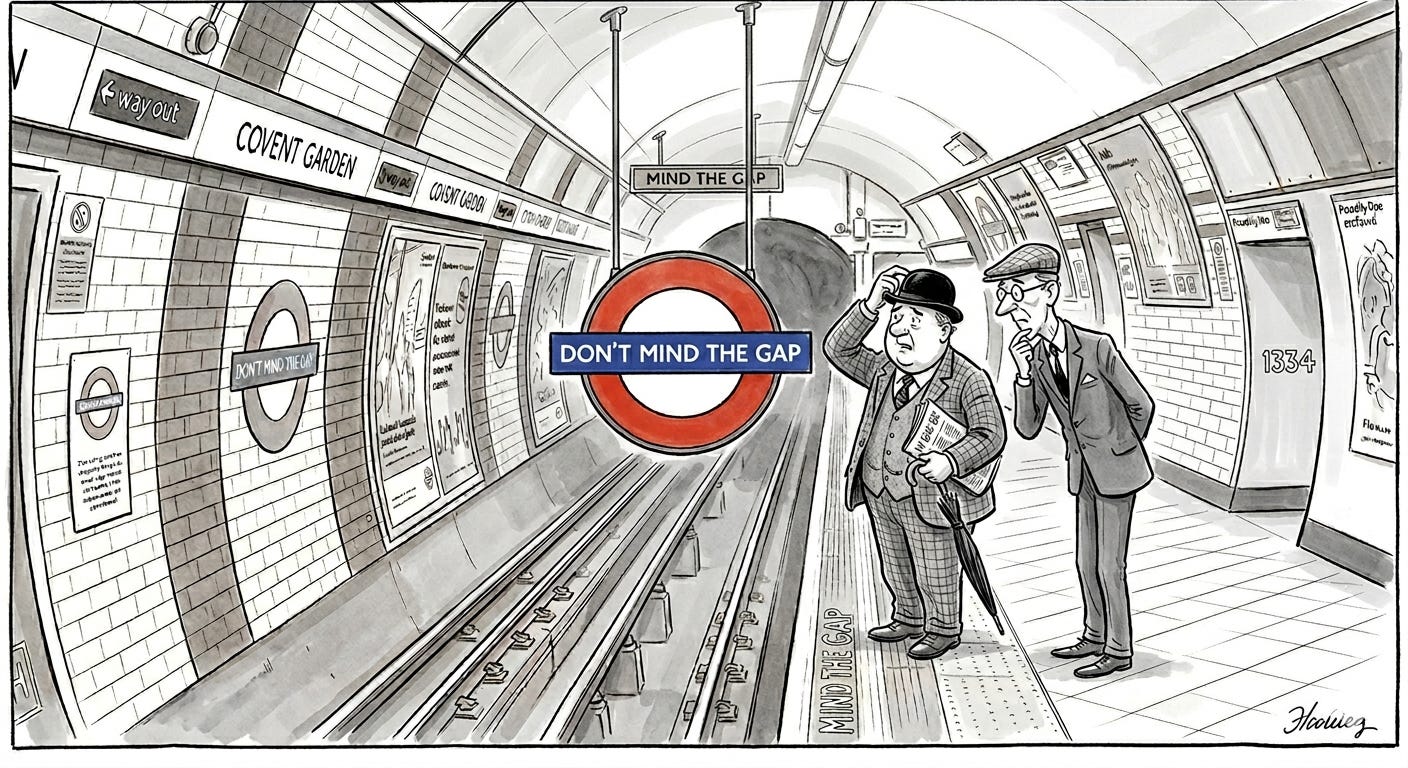
Don't Mind the Gap
The gap on your resume is NOT a problem. Bad employers are the problem.

One IC hire I made had a pretty good sized gap in his resume timeline. After a series of food service jobs early in his career, then some good customer support experiences he had a 7 month gap. Now, this was before COVID, before the big disruptions that the pandemic brought and long gaps were often met with heavy scrutiny. Navid (not his real name) had a sibling that suffered some very serious mental health challenges. Instead of watching their suffering from afar Navid quit his support job, moved halfway across the country and into his brother’s house. He took over a lot of the daily challenges and helped his brother get the help he desperately needed. It was not easy, as I later learned. And without getting into any more details I can say it was nothing short of heroic. If Navid had not shared some of this with me, he might have been overlooked. At the same time, if he had overshared early on that could also have steered the hiring committee away. There’s a balancing act needed here, and I’ll get to that further down.
What I wish more candidates understood, before they spend half their interview defending themselves, is that the resume gap you are embarrassed about is usually a non-issue from my side of the table. I am not the one bothered by the gap. You are.
I wrote before about Tracy, a former massage therapist that I hired to be an IC at a SaaS company. She didn’t have a tidy linear resume either, she didn’t apologize for that, and she turned out to be one of the best hires I have ever made. This piece is the companion to that one, from the candidate’s side of the table.
The industry has trained candidates to be defensive about gaps. Bad managers and worse hiring software have made it so that any non-linear resume needs to be preempted, footnoted, spun. The result is an interview where, even if I have not said a word about it, the candidate volunteers the explanation themselves. “You’ll see there’s a gap there from 2022 to 2023, and that’s because...” And we’re off.
I don’t think gaps are negative marks. I have not asked. I am not bringing it up. And here you are walking me through your medical history.
It’s uncomfortable for the candidate, it’s TMI for me. So here is the version that I hope works. You stepped away from work to care for a parent who was sick. They passed away three months ago. You’re ready to re-enter the workforce. The right way to tell me that is, “I took time off to care for my mom. She passed away three months ago. I’m re-entering the workforce now.” That’s it. That’s your whole answer, please.
The bad version is twelve minute of a House episode. The diagnosis. The treatment timeline. The siblings who didn’t help. The financial part. The why-it-had-to-be-you. All of which is real, and human, and not for this room. There is a time and a place for that conversation. An interview is not it. Don’t think me heartless, I’m the bleedingest bleeding heart around. I want you to take a beat and think if a Zoom call with the hiring committee is the best place to trauma dump.
I say that with care, because I have sat across the table from a lot of people who needed to share, and I know the need is bigger than the rule against it. Part of why I’m writing this is that I want candidates to have permission to say less and not feel like they’re hiding anything. You aren’t hiding anything. You’re just respecting the room.
Hello career-changers, this part is for you specifically.
The biggest mistake I see is career changer candidates trying to launder their previous work into something that sounds more like support than it really was. The teacher who suddenly has “managed customer escalations” on her resume when what she did was talk to parents at pickup. The bartender who lists “real-time conflict resolution” instead of just saying he worked the late shift at a rowdy bar.
Don’t do that. Own the work you actually did and then tell me what about it transfers. Setting expectations and coaching. Hitting goals and working with humans who are sometimes upset. Those are the skills, and they show up inside almost any people-facing job, and you don’t have to translate them into HR-speak for me to see them. But just as an aside: if a former bartender or bouncer did note they participated in “Managing a rapid-cycle decoupling of physical entities to minimize operational downtime.” I would be so there for it.
Other people I have hired with non-traditional shapes on the resume, off the top of my head: a couple of folks coming back to work after years as home healthcare aides for ailing or dying parents. The pizza driver. Tracy (massage therapist). A few people whose resumes had a long quiet stretch I never asked about.
A common thread runs through a lot of those hires. Endurance. Whatever they were doing during the years that don’t look “professional” on paper, they were doing it for a long time, and they kept showing up. That tells me something I cannot get from somebody whose career has been a tidy series of two-year stints between which nothing visible happened.
Now, to make a liar of myself: there ARE some gaps that do give me pause.
The one I look at hardest is the pattern. Eighteen months at a job, three months off, eighteen months at another, three months off, repeat. That situation across an entire resume tells me something is going on. Either the person is getting let go on a cycle, or they are leaving on a cycle, and either way I want to understand the why of it before I sign someone up for the team.
I won’t always ask and I’m not assuming the worst. Sometimes the reason is great, sometimes I’m just not worried about it.
A different version of this. I had a candidate tell me, mid-interview, that they had a three-year gap because they had been in prison. I didn’t ask what for. That’s not my business. They were otherwise a strong fit, so I moved them forward to HR. If they couldn’t pass the background check because of a workplace-violence or theft history, HR would handle that. I wasn’t going to handle it for them by closing the door before the conversation even happened.
Everyone gets a fair shot in my world. The pattern is the thing I ask about, not a single gap.
The post I am not writing here is one that tells you what to put on the resume to disguise the gap. That post exists in eleventy-billion other places on the internet. I think it’s bad advice and I think it teaches candidates to show up to interviews as a slightly worse version of themselves.
If your resume has a strange shape, that is still information about you. It is not a flaw to cover up. The candidates who walk in and own that information without apology are usually the ones I like to hire.
And just for fun, here’s a few more euphemisms for breaking up fights in a bar reworded into corpo-speak:
De-provisioning aggressive physical engagement loops to restore workplace harmony.
Executing an unscheduled, force-majeure separation of high-friction assets.
Deploying a hard-stop intervention to effectively pivot all active constituents from a state of kinetic chaos back into a state of stationary, synergistic compliance.
Thanks. I love you. Bye.